
Before You Sign Up: Reading a Pool's Front Page in Numbers
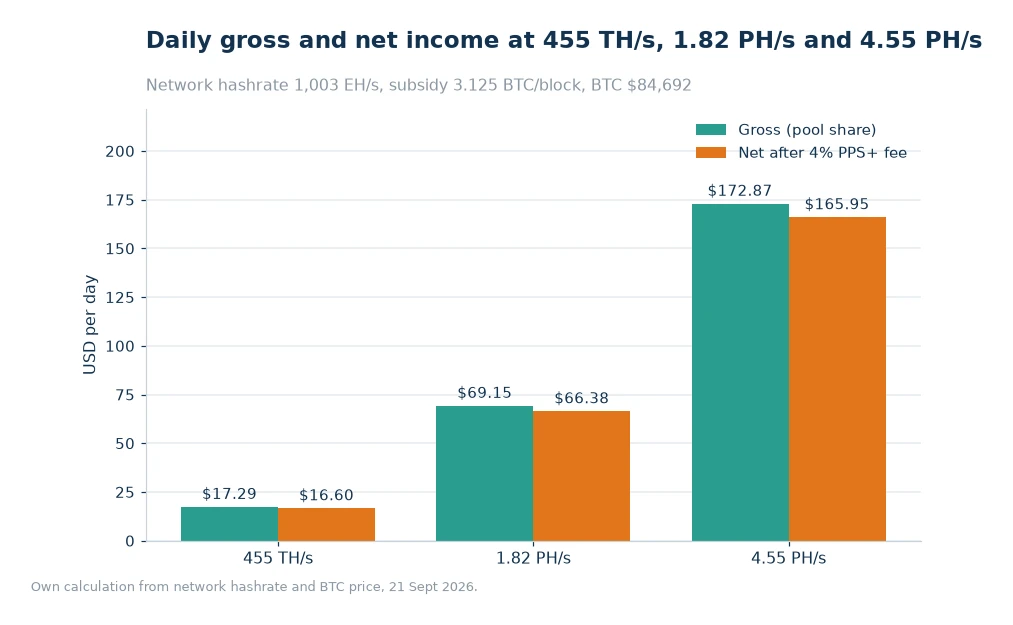
A pool's front page sells scale — 150+ countries, 1M+ users, 20+ coins — and scale is the least useful number for a new miner. The useful ones are smaller. At 455 TH/s the daily gross is $17.29 and the net $16.60; at 1.82 PH/s it is $69.15 and $66.38; at 4.55 PH/s, $172.87 and $165.95, with BTC at $84,692 and the network at 1,003 EH/s.

Key takeaways
- Three reference sizes produce $17.29, $69.15 and $172.87 of daily gross at the read-date price.
- Net figures are $16.60, $66.38 and $165.95, about 96% of gross at each size.
- The listed 4% applies to the PPS-settled block reward, not to every dollar of income.
- Scale claims describe the pool; the payout history describes your account.
The Claims You Can Check
Coverage and user counts are marketing, and there is nothing wrong with that as long as they are read as context. They tell a newcomer that the service operates at a certain size and has survived long enough to accumulate users. They say nothing about what a specific machine will earn next month, and next month is the only period a new account can plan for.
The checkable claims are different. A pool publishes its hashrate, its fee schedule and a calculator. Those three can be compared with a competitor in an afternoon, and they are what a decision should rest on. The front page is a starting point; the numbers behind it are the argument.
Three Sizes, One Formula
The chart takes three reference sizes and applies the same arithmetic to each. Gross income is share of the network multiplied by the daily issuance, then valued at the BTC price. Net income applies the listed 4% to the block-reward component, which is where nearly all of the income sits when transaction fees are ordinary.
The three sizes are useful because they span the range a new account is likely to occupy: a single large machine at 455 TH/s, a small group at 1.82 PH/s and a modest container at 4.55 PH/s. The proportions hold across them, which is the point of a formula rather than a table of promises. Double the hash rate and the gross roughly doubles; the net follows at the same ratio, so a comparison made at one size carries over to the next.
Why Net Is Not Gross Minus Six
A common mistake is to add the two listed rates together and expect a 6% deduction. That is not how the schedule works. PPS+ charges the listed 4% on the PPS-settled block reward and a listed 2% on the transaction-fee component, which is a much smaller base in normal conditions. The blended deduction therefore sits near 4%, not near 6%.
At 455 TH/s the difference between $17.29 and $16.60 is 69 cents a day, or 4.0% of gross. If the fixed-six assumption were right, the net would be about $16.25 instead. The gap is small per day and grows with size, which is why the assumption matters more to a container than to a single machine.
Where the Coins Land
Payouts arrive in the pool account, and from there they can stay in the built-in wallet or move to an external address. The ViaBTC Mining Pool account is the same identity across the pool, the wallet and the tools, which simplifies the first setup: one login, one payout address, one place to see the history.
A new miner should decide the destination before the first payout. Leaving coins in the account is convenient and keeps them ready for conversion; withdrawing on a schedule is simpler to account for. Either works, but the choice should be deliberate rather than a default that nobody remembers setting. Write it beside the payout address so the next person to touch the account can follow the same rule.
The multi-currency wallet holds several coins under the same account, which matters once merged mining or multiple algorithms enter the picture.
The First Week Checklist
Four things are worth confirming in the first week. The worker connects and reports the expected hash rate. The credited amount matches the calculator within a few per cent. The payout arrives when the documentation says it will. The fee line matches the schedule rather than a remembered number.
Each of those is a comparison, which means each needs a written expectation first. Spend ten minutes before signing up to record what the calculator says at your hash rate, then check against that rather than against a feeling. A discrepancy in week one is a support question; the same discrepancy in month six is a habit. Keep the note in the same place as the invoice, so the two can be read together when the first month closes.
What a Multi-Coin Pool Asks You to Decide
Twenty-plus coins means a choice of what to mine, and that choice is not only about which coin pays most today. It also determines which hardware is useful, which wallet balance accumulates and which network's difficulty the operator has to watch. A miner who switches coins weekly is running a trading strategy, not a mining plan. The hardware, the power and the pool account stay the same while the target moves, which makes the comparison impossible to finish.
A simpler approach for a first account is to pick one coin that matches the hardware, mine it for a full difficulty cycle, and use that period to learn the statement. Adding a second coin afterwards is easy; interpreting two unfamiliar statements at once is not. The first cycle also shows how much the daily figure moves on its own, which is the baseline any later change should be measured against.
| Hash rate | Gross per day | Net per day | Deduction | Retained |
|---|---|---|---|---|
| 455 TH/s | $17.29 | $16.60 | $0.69 | 96.0% |
| 1.82 PH/s | $69.15 | $66.38 | $2.77 | 96.0% |
| 4.55 PH/s | $172.87 | $165.95 | $6.92 | 96.0% |
Worked example
The 455 TH/s case, from network share to a net daily figure.
- Daily issuance: 144 blocks × 3.125 BTC = 450 BTC.
- Per terahash: 450 ÷ 1,003,000,000 = 0.00000044865 BTC.
- At 455 TH/s: 455 × 0.00000044865 = 0.00020414 BTC a day.
- At $84,692: 0.00020414 × 84,692 = $17.29 gross.
- Listed 4% on the block-reward component: 17.29 × 0.04 = $0.69.
- Net: 17.29 − 0.69 = $16.60.
- At 1.82 PH/s: 1,820 × 0.00000044865 = 0.00081655 BTC, or $69.15 gross and $66.38 net.
- At 4.55 PH/s: 4,550 × 0.00000044865 = 0.00204138 BTC, or $172.87 gross and $165.95 net.
Frequently asked questions
Is the listed fee really 4% in total?
Close to it, when transaction fees are ordinary. The schedule lists 4% on the PPS-settled block reward and 2% on the fee component, so the blended rate sits near 4% rather than at a fixed six per cent of gross.
How many users and countries does the pool serve?
The site describes service to 150+ countries and more than a million users. Those figures describe the platform's reach and should be read alongside the hashrate and fee pages, which are the numbers that affect an individual account.
What should a first-time miner check before depositing hardware?
The payout address, the worker naming convention and the fee schedule. Then record the calculator's expected daily output so the first statement can be compared with a number rather than an impression.
Start With a Number, Not a Claim
Open the calculator, enter the hash rate of the machine in front of you and write the daily figure down. That single line turns the front page from a brochure into a benchmark. The fee schedule supplies the deduction, and the first statement supplies the verdict.
Scale is a reasonable reason to feel comfortable with a service and a poor reason to choose one. The numbers that decide the outcome are small, local and easy to verify — which is good news for anyone willing to spend an afternoon on them.
Home, wallet and pricing pages at ViaBTC[1] were read 21 Sept 2026; the calculation uses 1,003 EH/s, 132.76 T, 3.125 BTC per block, 144 blocks a day and BTC $84,692. Published 24 Oct 2026. Net figures apply the listed 4% to the block-reward component only.